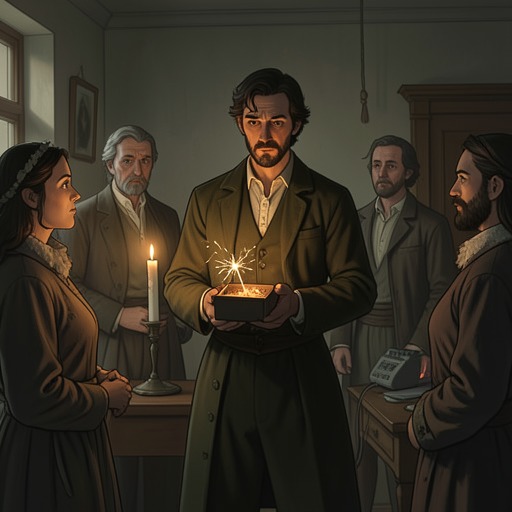
Pop agrees to Mariette and Mr Charlton's marriage
The Darling Buds of MayPop’s agreement to Mariette and Mr Charlton’s marriage is both a family decision and a public act: amid the smoke and fireworks of the garden celebration, Pop gives his consent, announces the match to the guests, and offers a toast to the couple. His spontaneous approval resolves the question of whether Mariette may marry, while his pride and sadness make clear that the moment is also a change in his relation to his daughter.
Background and the Growing Bond
Mr Charlton first enters Pop’s household in an official capacity: he is the tax inspector who informs Pop that no income return has been filed for the past year. Pop responds not by addressing the form but by pressing hospitality on his visitor, offering dinner, tea, coffee, beer, Guinness, and cider. At the crowded table, where pineapples share space with fish-and-chips, ice cream, jam, and tea, the official is drawn into the household’s abundance. The contrast between the tax inquiry and Pop’s insistence that the visitor eat and drink sets the pattern for a relationship that moves beyond its bureaucratic beginning.
The welcome becomes practical as well as social. When Mr Charlton tries to leave, he learns that the eight o’clock bus has been discontinued since petrol rationing began. Pop invites him to stay the night, and Ma agrees; later, she also urges him to join the family for Sunday dinner rather than settle for a cold meal at the pub. The repeated offers of food and lodging give Mr Charlton reasons to remain in the family’s orbit, even as Pop jokes that he should take advantage of the National Health service and go sick. The book thus prepares the eventual marriage consent through a gradual crossing of boundaries: the tax official becomes a guest, a participant in farm life, and finally a prospective son-in-law.
Mariette’s attraction to Mr Charlton becomes unmistakable in physical, impulsive encounters. She touches his cheeks and kisses him; later, she pins him against the newel post of the dark stairs and kisses him again. Mr Charlton is left torn between his attraction to her and his bewilderment at the family’s manner and surroundings. Pop’s invitation to stay a week, and then through the following weekend, expresses the household’s easy acceptance of his continued presence, even before the question of marriage is put directly to him.
From Official Visitor to Family Member
The shift is not only romantic. In the strawberry-picking tent, Pop introduces Mr Charlton to the foreman, Mr Jennings, as Charley and a friend, then explains that he is an office man from the tax business. Mr Jennings offers him work weighing and recording baskets, a position that gives Mr Charlton a way to take part in the family’s seasonal work. The official who came to investigate Pop’s unfiled return is now embedded in the activity and daily routines of the farm.
Pop’s attitude to public institutions also shapes the household’s view of Mr Charlton’s future. He encourages him to use the National Health service and take sick leave, presenting the service as something Mr Charlton has paid for and should enjoy. Much later, when the question of returning to the tax inspector’s office arises, Mr Charlton says that leaving would cost him his pension. Pop dismisses the attraction of a pension as a poor bargain after forty years of work and proposes a different future: a bungalow for Mariette and Charley, built from materials salvaged from a mansion he intends to demolish. His consent to the marriage sits within this larger vision of drawing the couple into the family’s practical and economic world.
Consent and Public Announcement
The decisive exchange takes place during the Larkin family’s fireworks celebration. Pop is moving through the garden, delightedly setting off fireworks, while Mariette and Mr Charlton struggle to get his attention. Mr Charlton finally tells him that Ma says Mariette may marry him if Pop will allow it. Pop’s answer is immediate: “Perfick,” he says, and adds, “Let her?—course I’ll let her.” Consent is expressed not as a formal negotiation but as the natural continuation of his warm, expansive welcome to Mr Charlton.
Mr Charlton then asks Pop to announce the engagement, explaining that Ma considers the occasion just right. Pop accepts the suggestion with the same spontaneous enthusiasm. A quarter of an hour later, standing on a chair outside the billiard room, he addresses the guests gathered in the smoky garden. He announces that Mr Charlton is going to marry his daughter Mariette and asks whether everyone has their glasses filled. The private permission has become a public declaration, witnessed by the assembled company.
Pop raises the toast, “Charley and Mariette.” A stunning explosion immediately knocks him yards backward. The interruption gives the ceremony its characteristic mixture of affection and disorder: Pop has made the announcement and offered the toast, but the fireworks refuse to let the moment settle into solemnity. Mr Charlton calls out, “One for his nob!” The comic blast does not undo the declaration; the engagement has been announced and toasted before the explosion breaks the scene open.
Meaning and Aftermath
Pop’s assent is decisive because it removes the paternal obstacle in the question Mariette and Mr Charlton bring to him. Yet the moment is not simply an endorsement delivered in private. By announcing the marriage himself, in front of the guests and with his glass raised, Pop takes responsibility for making the relationship part of the family’s public life. The invitation to eat, the overnight bed on the billiard table, Sunday dinner, and the work in the strawberry tent all lead toward this visible act of inclusion.
The announcement carries two tones at once. Pop speaks with imperial pride, delighted to welcome the marriage, but there is also a certain sadness in his voice as he tells the guests that his daughter will marry. That sadness does not turn into resistance: his answer to Mr Charlton is immediate, and his willingness to announce the match follows just as quickly. The fireworks make the scene noisy and unstable, while the toast gives it a clear centre. Pop’s welcome has become consent, and consent has become a family celebration.
His subsequent offer to build Mariette and Charley a bungalow near the bluebell wood extends that welcome into a promise of a shared future. The promise is later deferred: Pop remains too busy with other enterprises to begin demolishing the mansion whose materials he had intended to use. Even so, the proposal shows the practical form his approval takes. Marriage means more than permission; Pop imagines a home for the couple within the landscape and working life of the family. In the longer aftermath, Charley leaves the tax inspector’s office, and Pop is pleased that no one in the family remains connected to what he calls the tax business. The marriage thus completes a reversal that began with the tax inquiry: the official who arrived to confront Pop’s nonfiling is accepted as a son-in-law, though his habits of paperwork and proper returns continue to differ from Pop’s own.